Smuggler’s Beat tour
The Edge of the WorldThe Smuggler’s Beat tour is both a demanding run of live shows and the setting in which Shay Maloney’s public identity and private life begin to come apart and be reconsidered. Planned to bookend the journey with Dublin and Derby in reference to Shay’s supposed Irish heritage, the tour instead makes that heritage uncertain, brings a genealogy documentary into conflict with personal trust, and gives Shay and Ollie Pietruska a moving, precarious space in which to draw closer.
Route, Expectations, and the Dublin Opening
The band rolled into Dublin after seven hours on the road, making it the tour’s first stop. The members left the bus in varying states of disarray; Shay was the only one without a hangover, less through discipline than because the refrigerator was at the front of the bus. The dressing room offered little comfort beyond a couch too small for five, a can of Pringles, and a tiny television. Shay nevertheless kept to his solitary pre-show routine. Neither a rough ferry crossing nor questionable tuna sandwiches displaced the circuit he made to acquaint himself with an unfamiliar stage.
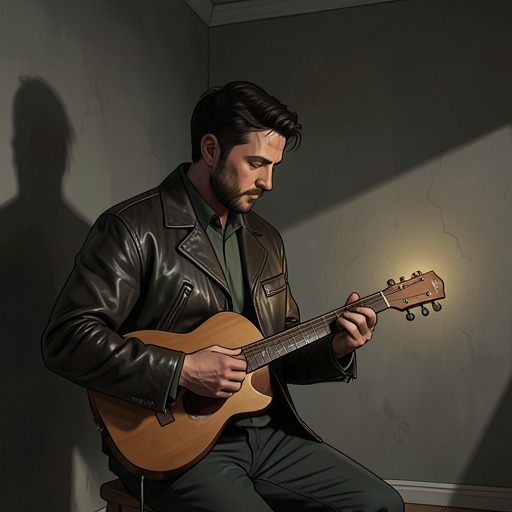
That ritual reveals how much the tour’s performances matter to him. Alone on the stage, Shay lay down with his eyes closed and imagined the lights going out and the crowd deciding whether it loved or hated the band. Smuggler’s Beat had a loyal following, but its eclectic shanty-punk sound was an acquired taste, and a new city did not yet feel like home. The record company had taken a chance on the group; the possibility of failure remained a persistent pressure in Shay’s mind. The venue itself, a three-thousand-capacity indie club, was dingy behind the scenes, with clutter in its corridors, but its weathered wood, high ceilings, and sticky floors matched his hopes for a live music venue better than the stadiums and arenas he dismissed.
Dublin also gave the itinerary a pointed personal meaning. Larry explained that the tour was meant to begin in Dublin and end in Derby, framing the route as a celebration of the band’s leader and his Irish heritage. Shay’s response was inward rather than celebratory: he privately believed his name was false and that he had no more Gaelic ancestry than Larry, who was Cuban-born. The proposed heritage-themed bookend thus introduced a contradiction at the heart of the tour: the route treated Shay’s Irishness as settled just as his own sense of it was unsettled.
The Tour as a Stage and a Film Set
The live shows were only one part of the work underway. Corina Hussain gave Shay a nondisclosure agreement between him and Sky, explaining that the researcher would not report what he saw while travelling with the band. She told Shay that the researcher would join the tour and film a documentary as it proceeded. The agreement made the camera an official presence on the road, but it did not mean Shay understood what the project was investigating.
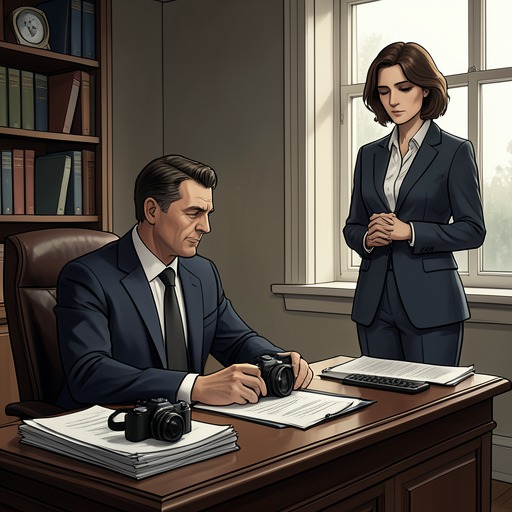
That gap became explicit when Ollie showed Shay a thick folder. Shay had assumed the documentary concerned his adoptive family; Ollie clarified that he was researching Shay himself, and indicated a name on the first page that Shay did not recognise. The disclosure landed abruptly. Ollie later felt guilty that Shay had had only a few seconds to react before being called away. When filming began, Ollie turned on the camera and told Shay that their initial conversation would be recorded; he also promised to remove their preceding discussion in the edit. The scene established a tension that would remain important to the tour: Ollie was simultaneously a researcher and camera operator, while Shay was the subject of an investigation whose purpose he had not fully understood.
The camera did not make every tour moment a formal performance. At a later show in Southampton, Ollie watched the band from the back of the venue with his still camera, considering possible shots. Ben was on his phone, Jumbo appeared to be asleep, Mara played piano, and Larry tapped a rhythm unrelated to the Rachmaninov she was playing. Against this loose backstage-to-stage disorder, Shay seemed absorbed in a song only he could hear. Ollie watched through his lens as Shay played penny whistle, the tune striking him as haunting and unmistakably characteristic of Shay. The scene contrasts the band’s unruly collective presence with the solitary concentration that had marked Shay’s first walk onto the Dublin stage.
Performance, Care, and Growing Attachment
Smuggler’s Beat’s practice of never repeating the same show made improvisation part of the tour’s identity. At the second Belfast show, Shay closed the set on penny whistle, but a flatness came over him and a mournful melody stayed in his mind. When the crowd called for an encore, Larry offered him the cajon drum. Shay declined: he felt compelled to play something entirely new. His bandmates recognised that he was about to depart from the expected routine; they stepped back but stayed close enough to join him if he signalled. Shay lifted a harmonica without knowing what would emerge. The returning melody had acquired a more tangible purpose, and he poured into its single notes what he could not put into words. The tour’s no-repeat convention thus made room for a performance formed in the moment, where uncertainty became the means of expression.
The tour also brought Shay and Ollie into a closeness that made the prospect of its end difficult for Shay. In a call with Frank Maloney, Shay counted roughly two weeks remaining and was startled by how quickly the time had passed. He could not quite contemplate the tour ending: Ollie would return to London, while Shay would go wherever his unsettled life took him. By the time the band reached Cardiff, less than a fortnight remained. Shay helped carry Larry’s bass drum up the stage steps while the band prepared for a demanding show. He and Ollie had spent two days speaking only about ordinary matters, and Shay clung to a note Ollie had left in his favourite lyric book asking for time. The request mattered because it came from Ollie, but the short time left on the tour made the pause feel consequential. Shay recognised that he had tried to force the intimacy Ollie had explicitly said would not happen, and regretted not having spoken more directly about what he wanted.
The road also exposed the limits of care when Shay became ill. On the bus, after he had been sick repeatedly, Corina ordered Jumbo to retrieve Shay’s bag so they could test his glucose levels immediately. The order reflects the practical urgency of Shay’s diabetes during the tour, while the surrounding moment is also one of physical vulnerability: Shay wanted Ollie rather than Corina’s well-intentioned intervention. The journey’s shared living conditions brought professional responsibility, medical care, and intimate need into the same confined space.
Departure and the Tour’s Unfinished Ending
The tour’s emotional high point did not resolve the relationship. After Shay and Ollie had sex, Ollie stayed awake watching over Shay and reading the news on his phone. He recognised that he had allowed Shay to love him and, as Shay’s touch brought his burn scars into his awareness, found that he wanted more of that touch. He searched himself for regret and found love instead, though he remained unsure whether he could return it as fully as Shay deserved. The tour had made their intimacy possible, but it had not removed Ollie’s doubts or made a shared future certain.
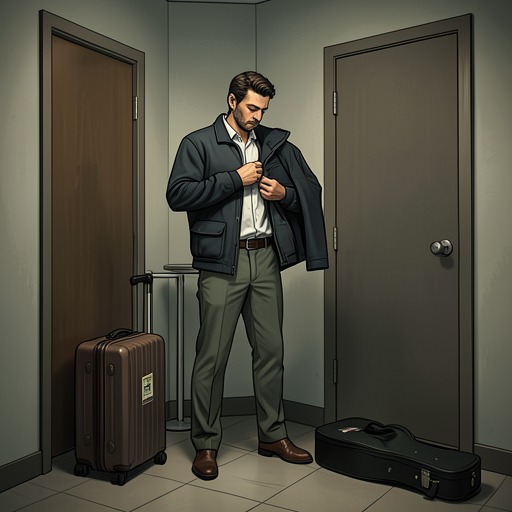
Ollie eventually left the tour, and three days later Shay and Ollie had neither called the other. Shay repeatedly picked up his phone, then put it down, trying to respect an instinct that told him to give Ollie space. The separation did not make the earlier closeness disappear: Shay remembered the stolen nights in Ollie’s flat, when Ollie had seemed open and free. But those memories sat beside darker moments, which Shay believed outnumbered the occasions when Ollie had truly smiled. On the band’s last London show, Jumbo asked whether Shay was excited to leave London and head north. Shay’s reply showed how thoroughly the tour had altered his sense of departure: he was not excited about leaving the city so much as going home.
Even the documentary’s access remained negotiable. When Shay wanted to hear a difficult story involving his mother, Ollie acknowledged that it would not be easy and offered to turn off the camera or go somewhere else. That offer matters in a project initially marked by Shay’s misunderstanding of its purpose: the person holding the camera could choose not to record, and Shay could choose where the conversation went. Across the tour, the stage and the lens both make acts of presentation visible, but the most consequential changes happen when performance gives way to uncertainty—an improvised encore, a concealed family history, an offered pause, or a departure without a call. The tour’s route may have been designed to frame Shay’s heritage; its deeper effect is to unsettle inherited identity while making the fragile bonds of chosen intimacy harder to dismiss.